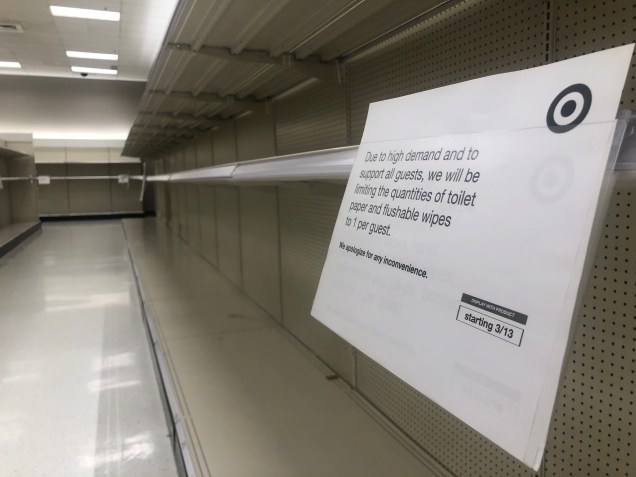
Bare shelf in Target after high demand of toilet paper due to the coronavirus. [Photo by: Linneya Gardner]With the current global coronavirus outbreak, there exists an underlying fear in the public. How that fear continues to be the forefront of everyday conversations and concerns could be in large part due to the media. Constant coverage of COVID-19–whether on T.V., in newspapers, or social media–is a constant reminder to people that there is something worthy of their full attention.
This was even seen in past outbreaks, such as the Zika, Ebola, and MERS infectious disease outbreaks. It is through these other phenomenons that “government agencies such as the Centers for Disease Control and Prevention (CDC) have started to use social media to inform the public of emerging infectious diseases,” according to an article inHealth Communicationjournal.
This can be seen in the case of MERS–a viral respiratory disease caused by a coronavirus–when it was found in the Middle East in 2015. The Health Communication journal discovered that the public sought out information on the disease via social media “because the government withheld necessary information.” Continue reading →
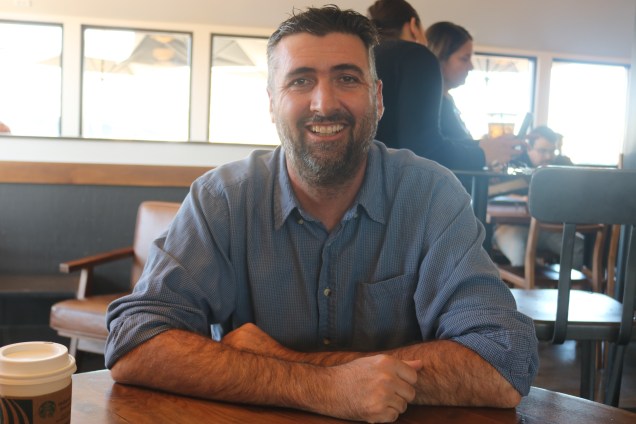
RJ Sangosti in the Starbucks close to his home where he gets most of his work done. [Photo by: Linneya Gardner]A young boy sits in a classroom, trying to read what’s in front of him, but struggles. He thinks to himself how he hates school because he can’t seem to read like some of the other kids. But when he exits the classroom and looks through a camera, he escapes into a world where he can be himself and finally see clearly. Photography becomes his outlet, part of his identity.
For RJ Sangosti, he was that young boy. From a young age he has been highly dyslexic, where reading and writing has just always been a struggle. But even through experiencing that ‘setback,’ Sangosti soon discovered that visual expression was what he was good at.
“My dad gave me a camera when I was five or six years old. I remember my mom saved up to get my dad this camera, but he then gave it to me because he could see that I was traumatized, and it just became part of my identity,” reminisces Sangosti.
After realizing that photography was something he was good at and made him feel good about himself, Sangosti chose to go through the art program at Colorado State University. It was there that he joined the Collegian, a student run newspaper on campus, and started gaining the experience that would soon lead him to where he is today, working as a photojournalist for the Denver Post.
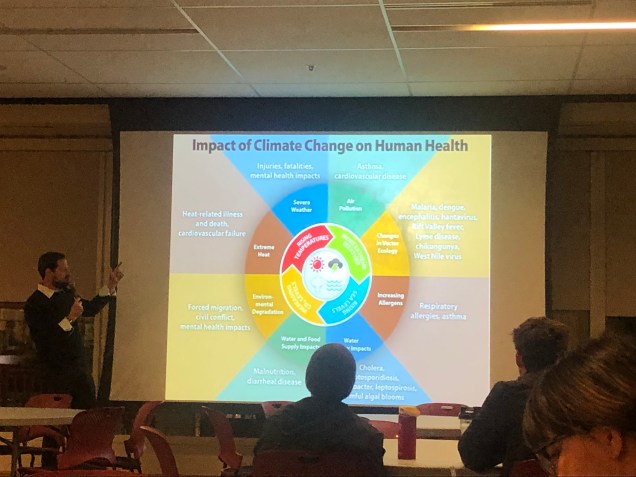
Jay Lemery describing the key impacts of climate change on human health. [Photo by: Linneya Gardner]By Linneya Gardner
The science behind climate change isn’t just in the effects it has on the environment, but the effects it has on individual human health. This is the concept Jay Lemery MD, a professor at the University of Colorado School of Medicine, focused on during his presentation held at the University of Denver’s Anderson Academic Commons on February 13.
Lemery’s lecture focused around creating a discussion that was centered around facts about climate change and how as humans we should be worried about our health along with worrying about the environment. He addressed the crowd of about 30 people with a slideshow that included pictures, quotes, graphs, and other background information. The audience was very attentive to his presentation, even as they sat eating the variety of free food that was provided.
He first gave background on himself so the audience knew he was a credible source on the topic; he did so by describing the courses he teaches such as wilderness medicine, polar medicines, global health advanced first aid, and Mars dessert medicine. In addition he has written books such as “Global Climate Change and Human Health” as well as “Enviromedics.”
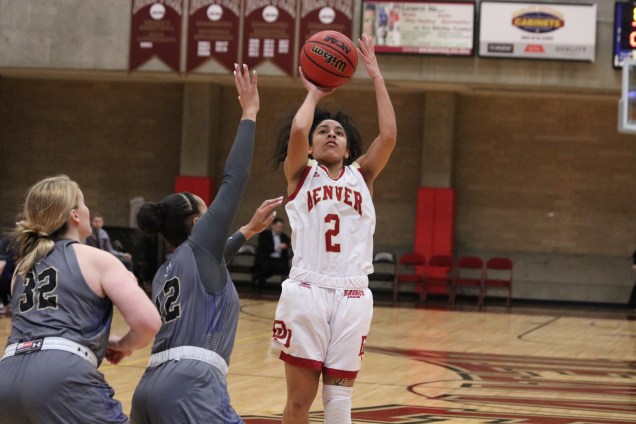
Guard Briana Johnson shoots a 3-point shot. [Photo by: Linneya Gardner]By Linneya Gardner
The University of Denver defeated Purdue Fort Wayne for an 83-57 win during the women’s basketball game on Saturday Feb. 8. After a close game through halftime with a score of 41-34, DU continued to pull away in the second half, moving their record now to 10-14, and 4-7 in the Summit League.
It was a slow start for both teams, with no shot being made until a full minute into the game. However with the sound of the crowd’s cheering and the coach yelling encouragement, it was clear that DU would soon find their footing.
Senior Madison Nelson finished the first period with 12 of DU’s 21 points. She continued to be a contributing asset to the entire game, finishing with 25 points out of the team’s 83. She was the highest scorer of the game, both teams included, and has proven to be a value to the team even more in the points she scored.
Flames engulfing the country of Australia. [Photo by Linneya Gardner]By Linneya Gardner
Australia has been a constant inferno since bushfire season started in September, with—according to BBC News—more than 24.7 million acres blackened by the devastating fires across the country. The entire nation is being affected, raising questions as to whether climate change is a contributing factor to the worsening flames.
2019 was an unusually dry and hot year for Australia, driven in part by the Indian Ocean Dipole (IOD), which is defined by differences in sea surface temperatures across the ocean. The IOD has contributed to reducing rainfall in regions of Australia, causing droughts which leaves the country vulnerable to bushfires.
Although it is currently winter season in Colorado, climate change is also a continuing conversation about the wildfires that occur during the summer months in Colorado. Colorado natives from the University of Denver especially, are quite familiar with the effect wildfires can have on an area.




 The MFJS Reporter -- Winter 2020 M-W