This was even seen in past outbreaks, such as the Zika, Ebola, and MERS infectious disease outbreaks. It is through these other phenomenons that “government agencies such as the Centers for Disease Control and Prevention (CDC) have started to use social media to inform the public of emerging infectious diseases,” according to an article in Health Communication journal.
This can be seen in the case of MERS–a viral respiratory disease caused by a coronavirus–when it was found in the Middle East in 2015. The Health Communication journal discovered that the public sought out information on the disease via social media “because the government withheld necessary information.”
They discussed it further in that “the media can affect the public’s perceptions of risks when the media arouse self-relevant emotions through vivid depictions of the risk issues.”
By defining self-relevant emotions as “transient feelings that arise from thoughts about one’s life and self,” they elaborated how fear is an example of such a feeling.
Because this has been proven in past epidemics around the world, it is only natural that the public will continue to turn to the media–particularly social media–when trying to get information on the current coronavirus outbreak.
Lynn Schofield Clark, Chair of Media, Film and Journalism Studies at the University of Denver, said, “We have a much more international media and a much more interconnected society; we know a lot more a lot more quickly. Operating in a 24/7 media cycle feeds into people’s awareness, fear, and concern about what is happening. When 9/11 happened it was a lot like this in that it was completely unsettling. Everyday the news story was about uncertainty and what might be the worst case scenario, and so I think the media is likely to produce fear because it is such an uncertain time.”
Uncertainty of the future is also a common fear among the public when media coverage is focused on providing information as fast as they can in such a competitive industry.
“On the one hand I think there’s a draw in wanting to have a big audience, but on the other hand there is the public service mandate that the whole purpose of news has been to serve the public interest and provide information to people to make better decisions for themselves. I think many media outlets are trying to do that but some are falling into the journalism trap of stenography–basically writing down what people say as opposed to actually trying to find what information is valid and how to convey that,” Clark said.
Psychology professor at DU, Apryl Alexander, agrees that the media is our main source of information but that not all media outlets are beneficial sources to stay informed.
“Social media is like a game of telephone and can contribute to misinformation about health problems. People should seek information from well-established, trusted health organizations such as the CDC, the U.S. Substance Abuse and Mental Health Services Administration (SAMHSA), and the World Health Organization (WHO). For instance, reviewing this guide and video series from WHO was so beneficial in examining my own risk. Having accurate information can alleviate anxiety and confusion on how to prepare next steps during a crisis,” said Alexander.
With each day providing different news on the progress of the coronavirus, it remains important to focus on one’s health and to not only trust social media as your source of information.
An article in the BMJ emphasized this point; “Geopolitical distrust and tensions make it difficult to cooperate and build trust during a major outbreak, and some social media content contributes to fear and misinformation or dis-information.”
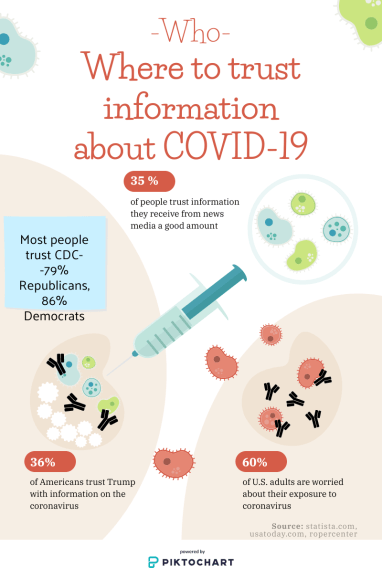
It is hard to know who to trust with information on the coronavirus. Between the news media, social media, President Trump, the CDC, and more, there are several outlets to receive your information–and not all of that information will be the same.
For example, the influenza pandemic in 2009 was a similar instance in that “although many were affected by these events directly, many more experienced the pandemic through their media consumption,” according to an article in the Sociological Inquiry.
In that article, they discovered that news media largely draws on the rhetoric of fear, meaning they thrive on fear-motivated news. The media often reports negative news, fear being included in that category, despite efforts to keep the public alert but not alarmed.
Fear is a powerful thing and whether coming from the media or the government, it can be used to “position publics so that they are amenable to governance,” said the article in the Sociological Inquiry.
Roddy MacInnes, photography professor at DU, is in coherence that the coronavirus is instilling fear in people because it’s a disruption to their daily life and to the schedules we have set out for each day. He believes that social media is a main factor that affects the public because we are all constantly feeding ourselves information, and when we notice multiple people talking about a single issue, we begin to feel like we need to join in the concern.
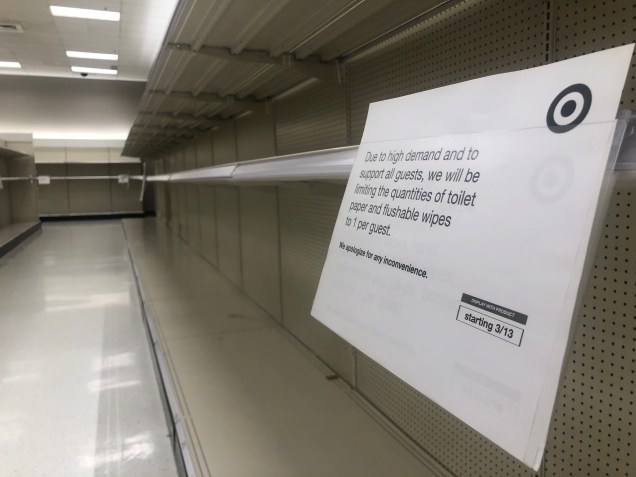
“The classic example is the toilet paper. I don’t see the toilet paper shortage written up in newspapers or anything, it was social media and word of mouth that brought it about. Toilet paper is manufactured in this country so there’s probably not going to be a shortage but all the shelves are emptied. But I’ve even succumbed to the frenzy because I got $500 worth of groceries the other day in case I have to hunker down,” said MacInnes.
Social media is mainly made up of images, images that shape our reality and cause us to feel feelings we wouldn’t have felt without seeing those photos, such as anxiety and fear. However, MacInnes is hopeful that all the hype around the coronavirus in the media will help people to take action and will bring people together.
“The positive side for me is that it brings people closer together; we have this thing in common now and are a bit more focused on what’s important in life, which I think is relationships. I remember that during 9/11, there was solidarity; we wanted to be close to each other. I find that just in the art building right now; there’s a different kind of atmosphere. We aren’t hugging each other but we feel closer,” said MacInnes.
We must recognize that any fear that information from the media produces in the public is fear that can be controlled and contained. Although the current coronavirus outbreak is scary, is full of uncertainty, and makes us feel uneasy, as Apryl Alexander put it, there are solutions to containing the issue.
“People fear a lack of control, but this pandemic is controllable. We were told that washing our hands, maintaining good hygiene, and maintaining appropriate social boundaries can lessen our risk of acquiring the virus, which results in symptoms similar to that of the flu. So why engage in excessive supply buying? We’re not doing this every annual flu season. Perceived loss of control made people panic,” said Alexander.
It’s important to be well informed, but not overly bombarded with information. We are all in this together, so what can we do now to help shape what our life will look like after this is over?
Maybe, just maybe COVID-19 will help us “value the in-person conversations even more,” said Clark.
 The MFJS Reporter -- Winter 2020 M-W