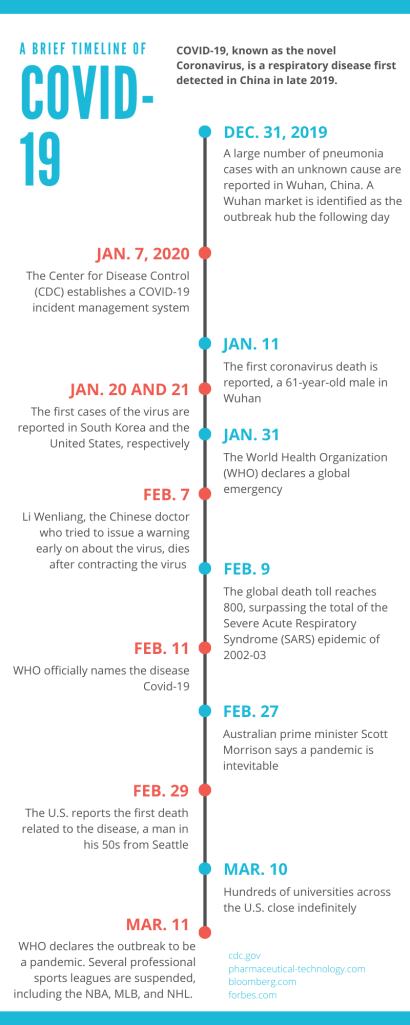
As a result of the outbreak, at least 135 colleges and universities have canceled in-person classes either indefinitely or until the end of the school year. DU has also canceled all in-person final exams and classes are scheduled to remain online until at least April 10.
In an announcement posted by the Center for Disease Control and Prevention (CDC) on March 9, institutes of higher education (IHE) were advised to “consider postponing or canceling upcoming student international travel programs.”
“Given the speed of spread and the number of countries experiencing community transmission, IHEs should evaluate the risks associated with choosing to maintain programs abroad and take the appropriate proactive measures,” reads the final paragraph of the announcement.
Amidst the chaos, the more than 150 study abroad programs offered at DU, with hundreds of students set to depart to their destinations between June and September, have also fallen into question. Several study abroad programs at several different colleges and universities, including DU programs that were scheduled to last through the winter quarter, have been recalled to the United States. The DU Office of International Education (OIE) said in an email on March 9 that the university “does not plan to cancel any study abroad programming that’s planned for the 2020-21 academic year.”
However, as confirmed cases worldwide continue to rise, health and travel concerns do as well.
“I think universities will err on the side of caution and not permit students to go to destinations where there are heavy outbreaks,” said Matthew Taylor, a professor of geography at DU and a frequent international traveler.
“I can only stay optimistic and hope that universities will be able to respond quickly to get students abroad as conditions improve in x or y country,” Taylor continued.
Taylor also predicted how the coronavirus may affect future study abroad locations of choice.
“Perhaps non-traditional study abroad destinations will see an uptick in students, like Central America,” he said.
Taylor specializes in studying Latin American geography and even traveled to Nicaragua on March 13 despite the growing panic across the globe surrounding the coronavirus.
According to a poll conducted by Quinnipiac University on March 5, 66% of Americans have confidence in the United States healthcare system to handle the response to the Coronavirus, based on 1,261 respondents. There is reason to believe that the number of people who responded confidently has decreased as the panic across the country grows stronger.
With the way that universities have responded to study abroad programs this quarter/semester and the fact that many universities have already canceled in-person classes for the rest of their respective school years, DU’s response to future study abroad programs is certainly one to anticipate.
Alisha Joycell Stanton had agreed to do an in-person interview on the topic, which she was initially enthusiastic about. Stanton is the OIE program manager overseeing students in Asia and the Czech Republic.
In an email, Stanton mentioned that the coronavirus and its effects on study abroad is “such an important topic,” and she was glad that someone was “on top of it.”
Unfortunately, after a meeting with university officials, Stanton emailed back to say that she was no longer allowed to do the interview, as the request was “shot down immediately.”
“I honestly didn’t know [the coronavirus response] was on that level of privacy,” Stanton said in the email.
Stanton offered to contact Uttiyo Raychaudhuri, who is the vice provost for internationalization at DU. Following this, Raychaudhuri also initially said he would be “happy to help” in providing any information about the coronavirus outbreak and the university’s response concerning studying abroad. However, after being sent questions via email, one of which requested information about how many DU students were forced to return from programs abroad this winter, he failed to respond.
While the university continues to keep information under wraps, presumably to avoid further panic from the community, studies have shown how restricting international travel may help to slow the spread of the virus.
In research conducted by Science Magazine, it was found through a model that “travel limitations up to 90% of the traffic have a modest effect unless paired with public health interventions and behavioral changes that achieve a considerable reduction in the disease transmissibility” (Chinazzi et. al.). The model also predicted that the “peak of the epidemic” will be reached “at the end of April-Early May 2020.” What China has done with a combination of a travel ban and public health interventions may prove to be the most effective, as reported new coronavirus cases in the nation where the disease originated have now slowed to single digits.
As of right now, it is still hard to know how the coronavirus may be contained by the time students at DU and at other universities across the country depart to their study abroad locations for the 2020-21 academic year. DU has made it more than clear that the safety of its students is a priority, and only time will tell whether or not coronavirus concerns will continue to be an overarching issue worldwide.
 The MFJS Reporter -- Winter 2020 M-W