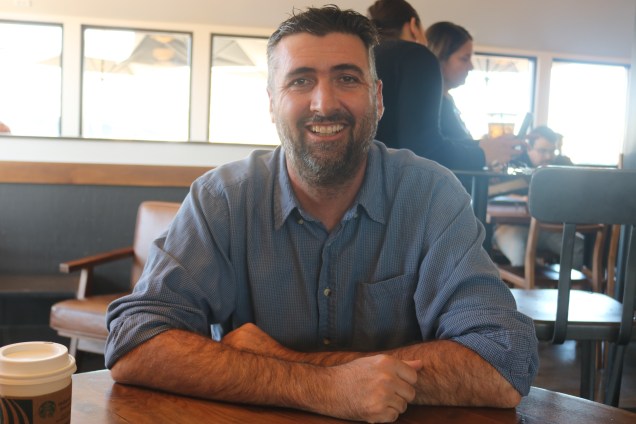
For RJ Sangosti, he was that young boy. From a young age he has been highly dyslexic, where reading and writing has just always been a struggle. But even through experiencing that ‘setback,’ Sangosti soon discovered that visual expression was what he was good at.
“My dad gave me a camera when I was five or six years old. I remember my mom saved up to get my dad this camera, but he then gave it to me because he could see that I was traumatized, and it just became part of my identity,” reminisces Sangosti.
After realizing that photography was something he was good at and made him feel good about himself, Sangosti chose to go through the art program at Colorado State University. It was there that he joined the Collegian, a student run newspaper on campus, and started gaining the experience that would soon lead him to where he is today, working as a photojournalist for the Denver Post.
Currently there are 10 photographers that work for the Denver Post, one of them being Sangosti himself. Most photojournalists secure a job by majoring in photography, journalism, photojournalism, or even economics, political science, sociology, or international affairs. Although it is a continuing necessary field to produce news and get it out as quickly as one can due to the competition of news organizations online, there is still a decline in jobs for photojournalists that are working in print. But even with the shift from jobs in print to jobs online, employment for photographers in general are projected to decline 6% from 2018-2028 according to the U.S. Bureau of Labor Statistics (BLS).
Also according to the BLS in 2018, the median annual salary for a photographer was $34,000. However with companies contracting more with freelance photographers rather than hiring their own, it is becoming more difficult to find a salaried job as a photojournalist. Because of this more photojournalists are becoming freelancers and realizing that it is their connections to people and companies that will keep them working.
While working for the Collegian, Sangosti learned this himself, how the industry is mainly about your portfolio and the people you know in the business. It was this realization that encouraged Sangosti to reach out to local papers and tag along with other photographers, being persistent and getting to know the people he knew could get him places.
“You just constantly have to make yourself present. This day in age I know people think they’re present when they’re on Instagram but you gotta have that human connection with people; you gotta show them your personal side, and you gotta show how you interact with people,” said Sangosti.
Working as a photojournalist for the past 16 years at the Denver Post has opened Sangosti’s eyes to the challenges people and the world faces each and every day.
“In the last decade, I’ve done some of the biggest stories in Colorado history. I was on the ridge during the Waldo Canyon fire, I covered 13 big floods that happened, I was a lead photographer during the Aurora Theater shooting which won Breaking News Pulitzer for the Denver Post, and I’ve covered a lot of environmental stories which I’m really passionate about,” said Sangosti.
Although not all stories that a photojournalist covers are negative ones, a majority of them are. Negative news tends to be the most newsworthy news, even though it makes it hard for the photojournalist to constantly be exposed to the sad and bad things of the world.
It is an incredible accomplishment for Sangosti to say he has won a Pulitzer prize for his photos during the Aurora Theater shooting, but it is the worst type of photography to have to do.
“That is the worst thing I’ve ever done in my entire career. I was shooting pictures of family members, not being able to talk to them, not being able to introduce myself and do the things that I do. I did the worst part of photojournalism and the worst part of this job and it was a Pulitzer. It’s just sickening to me. I hate it, I hate everything about it,” described Sangosti.
To be a photojournalist, one must know the challenges that come with the job. It’s a job where it is just a given that you will be put in hard situations and have to witness some of the most difficult parts of life. But being curious and a genuine person are some of the most needed qualities to be a good photojournalist.
“You gotta have empathy, gotta be strong, and stand up for things in certain circumstances and put yourself into places that take a strong will,” said Sangosti.
Although photojournalism is a career that requires a lot of a person, it is also a job that allows one to travel all over the world and meet all types of people. Photojournalists that work for newspapers, like Sangosti, also are most often provided with photography equipment to assist them in their stories. They get to cover all types of stories, and do so in the hope that change can be made in the world.
“Why I do this is really to make our governor, our mayor–like while he’s eating his cheerios, looking at the paper–see something and maybe change something,” said Sangosti.
In order to spark change in the world, one must address difficult topics, which is all part of a photojournalist’s job. But even though he has to put out negative news, Sangosti recognizes the significance of showing the people he is covering who he is and why he cares.
“I’ve always tried to be present, and I know people may not always appreciate me being there and covering, but I want them to know who I am, why I’m there, and at least have my name. It just helps me for some reason to be able to introduce myself and say, ‘hey I’m sorry I have to do this but the world is watching right now,’” said Sangosti.
It is important to know that not everyone will like what you cover or report, but there are people who will appreciate the work you are doing, which can help reaffirm why you do what you do and why it’s necessary to report all types of news. This rang true for Sangosti after shooting a particular image covering the Aurora Theater shooting.
“One of the biggest compliments I’ve ever gotten is from Tom Sullivan who lost his son during the Aurora Theater shooting. I took one of the pictures that was part of the Pulitzer thing which was of him, his wife, and daughter coming together for the first time as they learned the news. It was just a horrific picture of a father, mother, and sister grieving. And he came up to me after the trial and said, ‘I wouldn’t want anybody to ever have to go through this but, I am glad you took the picture because it gives a face to what I’m going through and shows the world what grief is.’ He was happy the world could see his pain because it helped him have an avenue to try to change something in the name of his son,” described Sangosti.
The career of a photojournalist is no small feat, but it is a necessary job that is the center for how we receive our news. Even though anyone could choose to be a photojournalist–for it is not necessarily required to have a college degree–it is still a job for those that can maintain passion and curiosity for people and the world.
Sangosti advises that photojournalists be genuine, empathizing human beings with a mind to persevere and make change in the world where change is needed. He is a pure example of how a photojournalist should present themself to the world when covering any type of story. It is through examples of his work and the way he approaches anyone he meets that it is clear how impactful he has been in the field of photojournalism.
“Be persistent and make yourself present, and not through social or emails. Get out and be face-to-face with people. Just be curious. Life is amazing and if you’re curious, there’s so many stories to be told. Be yourself and tell those stories that you are passionate about and have some kind of interest in because if you don’t, it shows. So feed off of who you are and your story telling process. Don’t get bogged down with equipment. A construction worker doesn’t have to think about his hammer and his hand. I find young photographers are fumbly with their equipment, so learn your stuff so when you are having that human interaction and present with somebody, you can be present and not a goofball trying to figure out his exposure,” advises Sangosti.
 The MFJS Reporter -- Winter 2020 M-W