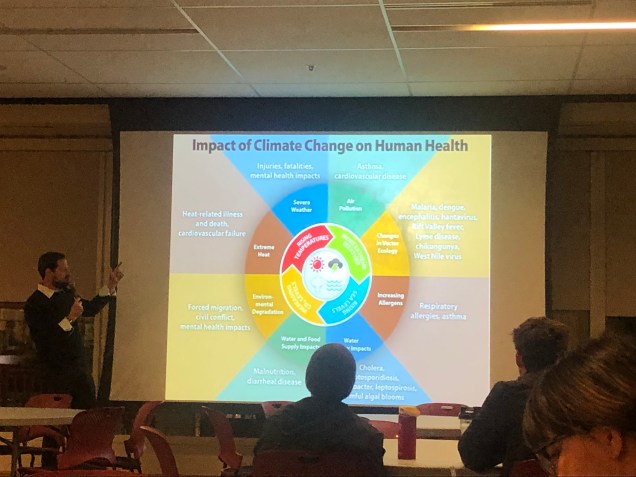
The science behind climate change isn’t just in the effects it has on the environment, but the effects it has on individual human health. This is the concept Jay Lemery MD, a professor at the University of Colorado School of Medicine, focused on during his presentation held at the University of Denver’s Anderson Academic Commons on February 13.
Lemery’s lecture focused around creating a discussion that was centered around facts about climate change and how as humans we should be worried about our health along with worrying about the environment. He addressed the crowd of about 30 people with a slideshow that included pictures, quotes, graphs, and other background information. The audience was very attentive to his presentation, even as they sat eating the variety of free food that was provided.
He first gave background on himself so the audience knew he was a credible source on the topic; he did so by describing the courses he teaches such as wilderness medicine, polar medicines, global health advanced first aid, and Mars dessert medicine. In addition he has written books such as “Global Climate Change and Human Health” as well as “Enviromedics.”
Along with Lemery’s many accomplishments and areas of teaching and research, he is ultimately passionate about helping others understand the implications climate change has on our present and our future. He depicted how climate change is a complex system, and when such a complex system gets energy it becomes unpredictable. He compared this with an experiment he did on his three-year-old daughter.
“I took the most complex system I interacted with, my three-year-old, and I took concentrated colored sugar and dumped it into a complex system. At first we saw a very linear relationship; we saw a super energetic child doing physiological feats of strength. Then something strange happened; we saw erratic behavior. This is climate change. Climate change is a toddler on sugar crack,” said Lemery.
By this Lemery meant that because climate change’s behaviors are so unpredictable, it is important that we know how to combat those behaviors, especially in regard to our health.
For instance, “We wanna talk about our parent’s risk of chronic lung disease and our kid’s risk of asthma,” Lemery said.
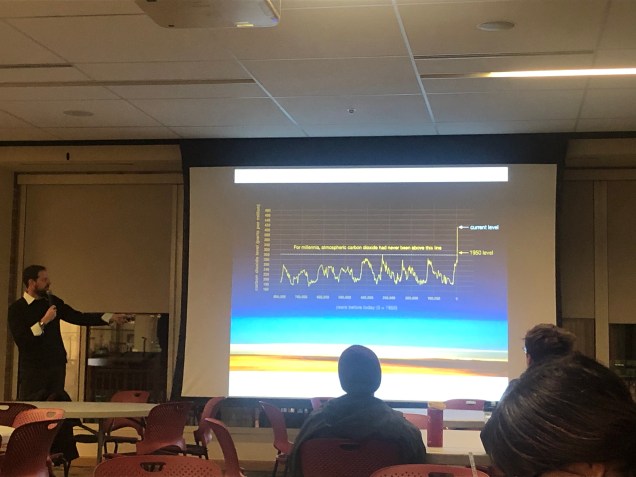
We are seeing more natural disasters being caused by climate change, heavy rains are more frequent, carbon dioxide is increasing, ocean heat content is rising, thickness of ice isn’t being replaced which leads to sea level rise, we see more heat related diseases, and people are being forced to migrate away from their homes. These are all factors affecting vulnerable people in negative ways, and yet not everyone is willing to accept that climate change is human caused.
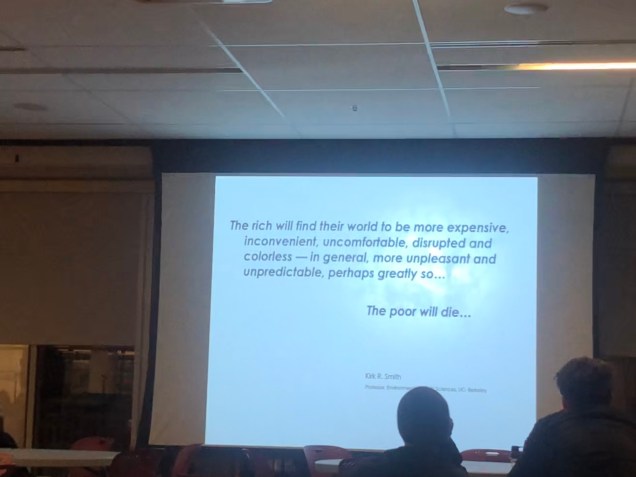
As Lemery continued giving several examples and statistics in his presentation, he kept emphasizing the fact that there is still hope.
He was clear that there is no argument anymore, that “no one in science is thinking this is anything but human caused.” He is encouraged that the science world seems to be on the same page, especially since it has helped further extensive research on the issue.
“The last few years we’ve really done some great progress. Lancet, one of the most prestigious medical journals around, said we are going to track this every other year until 2030 and do full inventories on climate change and health,” stated Lemery.
Even with action being put toward creating a healthier future, this is the time for us to speed up not slow down. There are still critics out there who don’t agree with the methods Lemery believes in and is teaching. But he is firm in his beliefs, especially that the pre-meds are the future leaders in creating change to combat this disease of vulnerability and disasters.
Lemery concluded with a thought-provoking set of questions: “Will we be remembered as the citizens of the age of great procrastination when we look back? People say you had all the information, it was all right there in front of you and nothing happened. Or can we get people to look back at us and say you were a generation that was enigmatic of the best attributes of the human spirit?”
 The MFJS Reporter -- Winter 2020 M-W